Jacopo Pontormo’s religious paintings are still a point of interest for intellects today, especially his work to the Capponi Chapel at the Church of Santa Felicitá. Pontormo does not simply illustrate Biblical scenes; he infuses his characters with blatant emotion. “At times, his characterizations become complex, detached, and even elusive; figures stare off from the limits of the picture plane and into the beholder’s space, their almond-shaped eyes adrift in distant wonderment,” says Josh Korenblat. Pontormo was at his dramatic apex when he did work for the Chapel. The altarpiece seems almost iconographic, following a continuing line of entombment scenes of Italian art. Most artists treat the Passion cycle in a reduced sequential manner, yet Pontormo’s altarpiece deviates from the path prescribed by these other paintings. Pontormo’s Mannerist style is evident since the boundaries of the picture plane become startlingly permeable. So the viewer isn’t passive but is an active participant in its formation. Given the complexity of the transitory nature of the altar’s primary subjects, the viewer and the frescoes, one has even less to reference when approaching Pontormo’s moving and lively altarpiece. John Shearman and Leo Steinberg, two Art historians, can’t even agree upon to whom the altarpiece is supposed to communicate, since it wavers between the celestial and the terrestrial, between heaven and hell. Korenblat describes the painting,
Despite the religious and celestial theme of the painting, the altarpiece has a distinctly terrestrial feeling. Pontormo uses the examples of Raphael and especially Tintoretto by incorporating the chapel space as the physical end of the scene, but Pontormo pushes these boundaries beyond what his predecessors ever did. Shearman favors entombment and the chapel space as Pontormo’s focal points, but Steinberg shifts his vision higher, to the dome of the Capponi chapel and to the heavens. He believes and tries to prove this by differentiating the sway of the virgin from the traditional entombment pose, which reveals Pontormo’s repugnance to rhetoric. The choice to make Mary swoon is a direct model from Michelangelo’s St. Peter’s pietá. So does the dark tomb and the figures surrounding it suggest a downword, hellish momentum or an upward, heavenly momentum? Steinberg argues that the surrounding figures negate a downward thrust, since the youths holding Christ do not look down or to the left and seem light on their toes, both indicating death. The drawing of God indicates that Pontormo sought the more ingrained emotions of the celestial father. In this way, Pontormo characterizes not only the suffering of Christ, but of the Capponi chapel itself. Ludovico Capponi commissioned Pontormo to paint the mausoleum space since he was anticipating his own death. Capponi imagined a "Throne of Grace", where God’s grace saves man from his sin. In the altarpiece “a whirlwind of figures spiral around an axis with a momentary, centripetal force--the figures neither bound to the earth nor fully enthroned in the sky,” states Korenblat. The best thing to do when analyzing Pontormo’s work is to accept the mysterious and neurosis complexity of his style. Throughout the image, Pontormo negates the conventional elements of an entombment scene. For a chapel infused with cold bodies in its sterile stone, only an altarpiece reflective of enlightened liberation, and not of death, seem appropriate. Pontormo did his work slowly and very subtly, so most likely his work is directed upward, toward the option of greater transcendence and implication. Pontormo made it this way so Ludovico Capponiand his family could rest in peace, with a visionary glance of salvation.
|
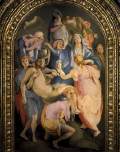 Deposition, c. 1528, Oil on wood, 313 x 192 cm, Cappella Capponi, Santa Felicità, Florence 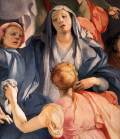 Deposition (detail) 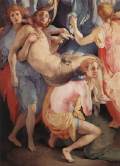 Deposition (detail) 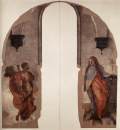 Annunciation, 1527-28, Fresco, 368 x 168 cm, Cappella Capponi, Santa Felicità, Florence 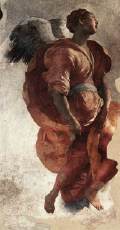 Annunciation (detail) |
