Jacopo Carrucci, or Pontormo, was born to Bartolommeo and Alessandra Carrucci on May 24, 1994 inside the castle of Pontorme, in the middle of the village of San Lorenz. Here he spent his early childhood learning the basics of painting from his father, who had been a disciple of Domenico Ghirlandaio. Pontormo’s father died when he was only five years old, and by 1504 both his mother and grandfather had passed. An orphan, he was then passed on to be taken care of by his grandmother, Brigida. Soon after, in 1508, a Florentine magistrate by the name of Dei Pipilli was made Pontormo’s guardian. In Florence, he often visited workshops to be apprenticed by important and influential artists of the time such as Leonardo da Vinci, Piero di Cosimo, Marriotto Albertinelli, and Andrea del Sarto, who halted Pontormo’s visits because he was jealous of his success with the fresco over the entrance to Santissima Annunziata. By his return to the castle of Pontorme in 1514, Pontormo was already a promising artist, since he had already painted a fresco on one of the doors of Leo X and painted two saints, St. John the Evangelist and St. Michael the Archangel, for the church on San Michele. These saints marked a pivotal moment in Pontormo’s artistic career, because it showed that his style was entirely Mannerist. Even praised by Michelangelo, Pontormo’s intelligence and skill was no secret. His distinctive restless style and unconventional effects of scale and space marked the departure from the peace and balance of the High Renaissance and the entrance to the agitated and fixated style of the Mannerists. Pontormo was first and foremost a religious painter, but he did paint several portraits. He attempted to display not only the outer identity of the subject, but the inner as well. He also dabbled with mythological subjects, since in 1521 he was engaged with the Medici family to decorate their villa at Poggio a Caiano. Although Pontormo enjoyed the protection from the Medici family, he never became a court painter such as Vasari. Also, it is evident through his work, Passion Cycle (1522-25) for the Certosa near Florence, that he was influenced by Albrecht Durer, whose woodcuts had been circulating through Italy. But Pontormo’s masterpiece in the Capponi Chapel of Santa Felicita, Florence is one of the most pure and key works of Mannerism; the emotional tension paired with vivid colors and striking figures flooded with grief are perfect examples of aspects of a Mannerist painting. Pontormo’s later life is marked with reclusiveness and neurosis, not unlike the characteristic state of many of his paintings. The frescoes in San Lornezo on which he worked during the last years of his life were never finished and are known only from drawings; Michelangelo’s influence is apparent in these drawings. These drawings, mostly done in black and red chalk, are important expressions of the Florentine tradition of draughtsmanship. Almost 400 survive today; the collection is considered to be the most pivotal body of drawings completed by a Mannerist painter. Pontormo died sometime around December 31, 1556. Drawings and paintings can be found in various galleries throughout Europe and America, and especially Florence.
|
||
 Self Portrait, 1554-1556, Red and black chalk, 61 cm x 46 cm / 24'' x 18'' |
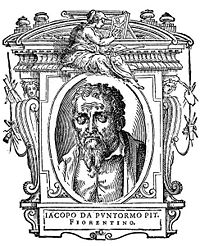 Portrait of Pontormo from an edition of Giorgio Vasari's Vite. |
|
